LPS Technology · LRF Refined Steel · Fe 550D · BIS IS 1786
TurboSteel Fe 550D LPS TMT Bars are refined through a Ladle Refining Furnace (LRF) before becoming reinforcement bars. This advanced process reduces phosphorus and sulphur, producing high-strength Fe 550D TMT bars with superior ductility, weldability, and long-term durability.
Low Phosphorus · Low Sulphur
Most TMT bars are produced within the permissible chemical limits of IS 1786. TurboSteel goes further. Through Ladle Refining Furnace (LRF) technology, phosphorus and sulphur are reduced to consistently low levels before the steel is cast into billets, creating a cleaner and more controlled metallurgical structure.
Lower phosphorus improves ductility and reduces the risk of brittle behaviour, while lower sulphur enhances weldability and structural consistency. The result is steel engineered for stronger reinforcement, improved fatigue performance and dependable durability over decades of service.
Lower phosphorus reduces the tendency of steel to become brittle under stress, helping the bar maintain flexibility during bending, seismic movement and long-term structural loading.
Lower sulphur improves internal steel quality by minimising sulphide inclusions, resulting in cleaner grain structure, better weld integrity and more consistent mechanical performance.

The Full Chain
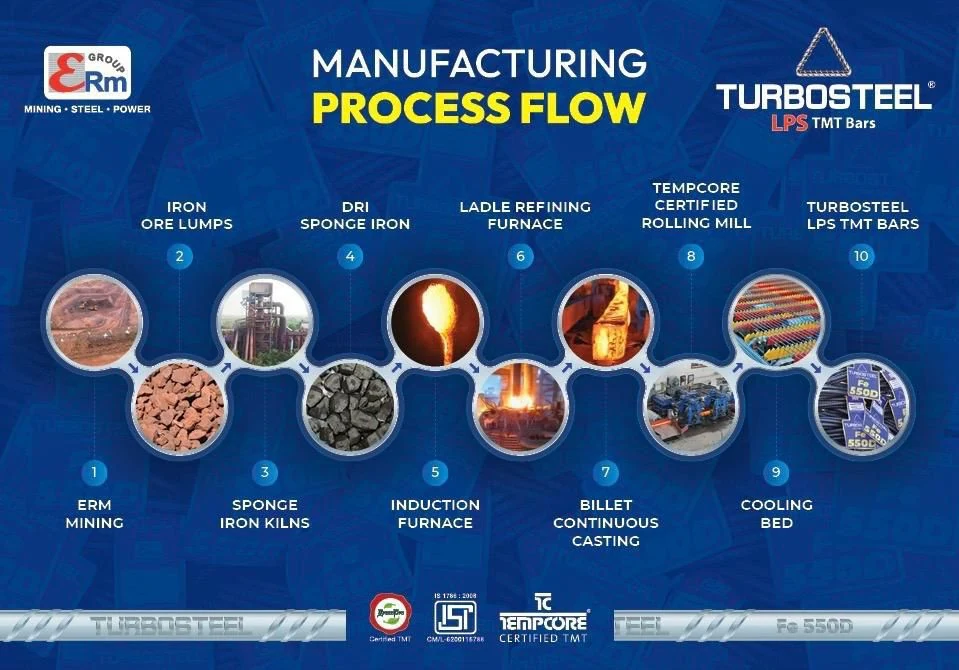
A TMT bar's performance begins long before rolling. TurboSteel controls the steelmaking process from iron ore and sponge iron through melting, LRF refining, continuous casting and rolling, with chemistry controlled at each stage.
The LRF process is central to TurboSteel LPS technology, helping control phosphorus and sulphur to produce cleaner steel before the billets move through rolling and TEMPCORE™ quenching to develop the required strength and ductility.
10 stages. One controlled process. One finished bar.
Performance · Fe 550D · Third-party verified
Published figures from IIT Madras, Bureau Veritas, NIE Mysore — not self-reported. Every bar, every batch.
+20 N/mm² above the IS minimum. A real engineering surplus.
+20 above ISTS/YS ratio 1.10 — above the IS minimum of 1.06. Ductile failure mode.
+45 above IS10% more elongation than required. Critical for seismic zones.
+5.5% above ISLower is better. TurboSteel stays measurably below the IS ceiling.
Below IS maxFurnace & Quenching
Not all TMT bars start the same way. The furnace and quenching technology determines chemistry and microstructure.
Standard Mills
Large Mills
TurboSteel
Quenching Technology
Third-party Verified
Every certification here was earned through independent testing — not self-declared.
The BIS Certificate of Excellence for Zero Product Failure means that across three consecutive years of independent testing, not a single batch of TurboSteel failed IS 1786 specifications.
This is not given for marketing. It is given for product consistency — the hardest thing to achieve in steel manufacturing at scale.
Get TurboSteel · Tamil Nadu · 38 Districts
Talk to us about your project — sizing, quantities, delivery across all 38 districts of Tamil Nadu.